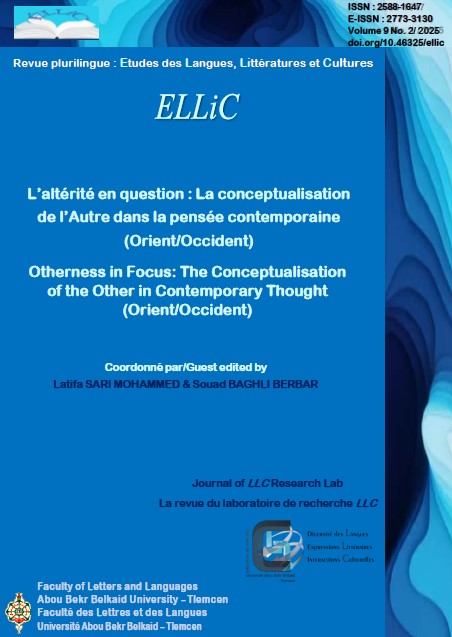
The Self in the Other’s Gaze: Neo-Orientalism in Hamza Koudri’s Sand Roses (2023)
DOI:
https://doi.org/10.46325/ellic.v9i2.193Keywords:
Otherness, Neo-Orientalism, Hamza Koudri, Contemporary Algerian literature, historical novel, regard de l’autre, Néo-orientalisme, Hamza Koudri, Sand Roses, roman historiqueAbstract
In the context of the Occident versus the Orient, the notions of self and other are fraught with reactions of rejection or endorsement, even of petrified identity. The Western gaze has always been haunted by the Orient, this close and intimate stranger. A further concept introduced by Ali Behdad in this field is Neo-Orientalism which is a form of Orientalism performed by Orientals themselves. The present article explores the Neo-orientalist discourse vented in Hamza Koudri’s novel Sand Roses, a perception ranging from the erotic and savage, to the exotic and mysterious, and construed as rather nefarious collaborations with Western agendas than genuine rendering of life in Bousaada in the 1930’s under French colonisation. Koudri’s novel can therefore be considered as an instance of rampant Neo-Orientalism whose self-proclaimed authenticity sanctions and authorizes disparaging visions of the self as if seen through the gaze of the Western other.
Résumé :
Dans le contexte de l'Occident versus l'Orient, les notions de soi et d'altérité sont chargées de réactions de rejet ou d'approbation, voire d'identité figée. Le regard occidental a toujours été hanté par l'Orient, cet étranger proche et intime. Ali Behdad a introduit un autre concept dans ce domaine, celui de néo-orientalisme, qui est une forme d'orientalisme pratiquée par les Orientaux eux-mêmes. Le présent article explore le discours néo-orientaliste exprimé dans le roman Sand Roses de Hamza Koudri, une perception allant de l'érotique et sauvage à l'exotique et mystérieux, et interprétée comme une collaboration plutôt néfaste avec les agendas occidentaux plutôt que comme une représentation authentique de la vie à Bousaada dans les années 1930 sous la colonisation française. Le roman de Koudri peut donc être considéré comme un exemple flagrant de néo-orientalisme dont l'authenticité autoproclamée sanctionne et autorise des visions dépréciatives de soi, comme si elles étaient vues à travers le regard de l'autre occidental.
Downloads
Published
Issue
Section
License
Copyright (c) 2025 Revue plurilingue : Études des Langues, Littératures et Cultures

This work is licensed under a Creative Commons Attribution-ShareAlike 4.0 International License.